Complete Facebook's phone verification without sharing your real number with advertisers.

Facebook asks for SMS verification on new accounts and during security checks; the number you provide can also feed 'people you may know' matching and ad targeting. Keeping your real number out of it is not just about security — it's a privacy decision.
A temporary number rented from Vernum completes the verification in minutes. The code shows up in your panel, your account opens, and since the number is released afterwards, no permanent link to you is created.
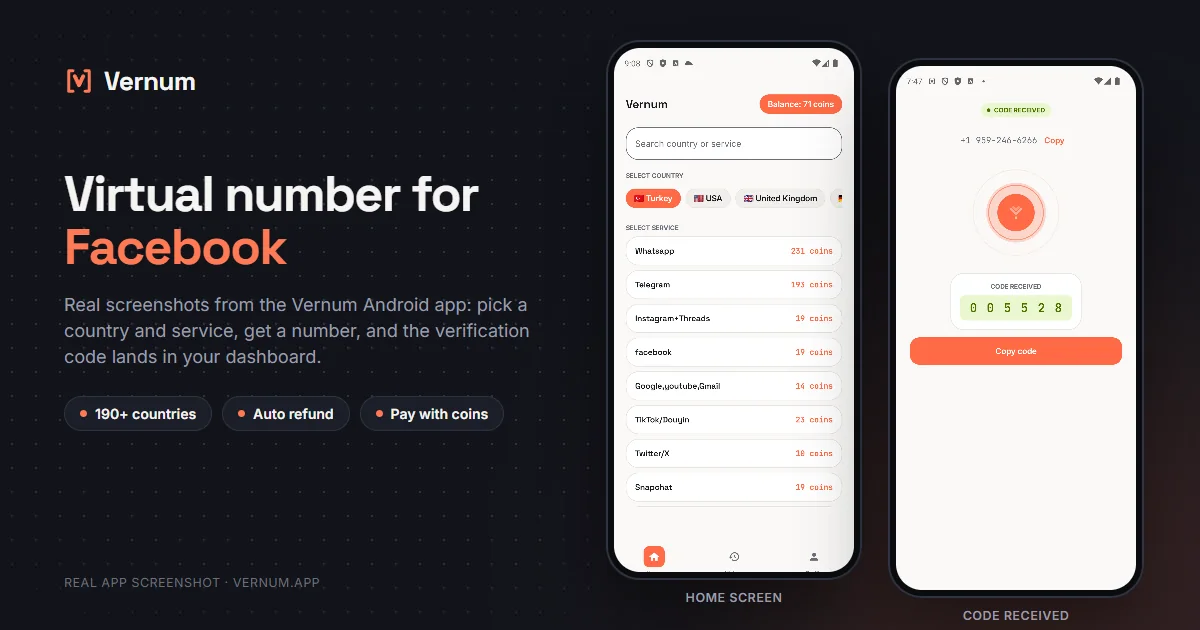
Select the Facebook service in the panel; countries are sorted by measured success rate.
A real number is assigned to you, ready to receive the code.
Enter the number in Facebook; the incoming verification code appears instantly in your panel and as a notification.
With Facebook's sign-up flow and the Vernum dashboard open together, getting the code takes a few minutes.
Facebook accepts numbers from a wide range of countries; US, UK and India offer a good balance of price and success rate. Heavily reused numbers can get rejected — the top countries in Vernum's success ranking point to fresh pools.
Catalog snapshot from 2026-09-05 — the countries where Facebook numbers are cheapest, in coins. 1 coin ≈ $0.01; see the catalog page for live prices and all 194 countries.
| Country | Price |
|---|---|
| 🇦🇴 Angola | 25 coins |
| 🇦🇿 Azerbaijan | 25 coins |
| 🇧🇬 Bulgaria | 25 coins |
| 🇧🇹 Bhutan | 25 coins |
| 🇨🇮 Ivory Coast | 25 coins |
| 🇨🇱 Chile | 25 coins |
Facebook sends codes to this number for login, recovery, and suspicious-activity checks. Once the number is back in the pool those codes never reach you, so remove it after verification and make email primary.
On the web form, a number typed without the plus sign and country code is read according to your own location and the SMS goes elsewhere. Always type the full format.
Facebook limits how many accounts one number can hold, and on Vernum the number is single-use anyway. Rent a second number for a second account.
For some numbers Facebook may choose to send the code through WhatsApp. A virtual number has no WhatsApp on it, so check that the SMS option is selected.
The more your Facebook account is tied to, the more your own number matters.
| Situation | Recommendation |
|---|---|
| Your main profile, Marketplace, and page admin roles | Your own number: Facebook sends a code to the phone during identity checks, and a virtual number cannot get you through that door. |
| A separate admin account for a page or group | Virtual number: you open it without linking your personal number; set up email and an authentication app, then remove the number from the account. |
| A one-time account for an event or listing | Virtual number: there is no need to give out your real number for short-lived tasks. |
| Attaching an ad account and payment method | Your own number: Meta's ad tools ask for extra identity verification, so go with a permanent number and real details. |
The country list is ordered by real measured delivery success — you choose by data, not luck.
If the timer runs out before a code arrives, your coins return to your balance on their own.
A live catalog refreshed hourly, with dozens of operator pools per country.
Verify a separate Facebook profile for Page or ad-account management without your real number.
Create a Vernum account, add coins, then pick a country and the Facebook service. A number is assigned instantly; enter it in Facebook and the incoming SMS code shows up in your panel.
Facebook may use verified numbers in its matching and suggestion systems — but since the number is rented and short-lived, that matching points to a disposable number, not to you. As long as you don't grant contact-list access, your real contacts can't be linked.
If the number expires before a code arrives, the coins you spent are refunded to your balance automatically. You can retry immediately with a different country or operator.
Yes — renting a virtual number and using it for Facebook verification is legal; it is a legitimate privacy tool for keeping your real number to yourself. Facebook's own rules are about how the account is used: fraud, spam or impersonation are prohibited there as on any platform.
The number is reserved for you until the Facebook code arrives; once the code shows in your dashboard and verification is done, the number goes back to the pool. If Facebook ever asks to re-verify you may not have access to the same number, so enable Facebook's two-factor authentication right after creating the account.
Vernum numbers are real carrier numbers and Facebook sends SMS to them. Facebook is cautious with new accounts and may not send a code to some numbers; when the timer ends your coin is refunded and you try again with a different country.
The number has returned to the pool, so you cannot receive a code on it. Facebook can also send the code to the email on the account or to an authentication app; set both up as soon as the account opens and do not leave the number as a recovery method.
Once the timer ends, the number is no longer reserved for you and any SMS that arrives later is not shown; your coin has already been refunded. Rent a new number, update it in Facebook, and request the code again.
Free receive-SMS websites list the same few public numbers for everyone. Anyone can read the codes on the page, and Facebook has usually seen those numbers many times, so they tend to be rejected or already tied to another account. A number rented on Vernum is assigned only to you for the activation window and the code appears only in your own panel. Numbers for Facebook start from 25 coins, and if no code arrives, the coins are refunded automatically.
Create an account, add coins and rent your first number in seconds. If no code arrives, the refund is automatic.
Go to dashboard →